
Cannibals of the Spirit — Gavin Graves
Simulacrum, Christian Mysticism, and the Eucharist
essay ☆
essay ☆
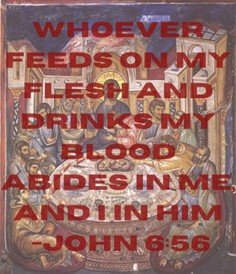
For 2,000 years, the Christian tradition has participated in the ritualistic consumption of God, through the Eucharist. The specific dogma of the Eucharist ranges on a spectrum of Christianity from belief in the actual consumption of the body and blood of Jesus Christ through bread and wine to more cavalier practices of symbolism, but the universal truth is that one must partake in devouring a form of divinity. Christianity views the Eucharist as an essential element in the process of becoming divine. Through cannibalizing the Spirit of Christ, you can draw closer to the Divine. Orthodox Christianity refers to this process as Theosis, the transformation of becoming like God and uniting with Him. Christ is the fulfillment of that transformation becoming both divine and human together; man is then both corporeal and divine.
However, cannibalizing the Spirit subverts the central idea of man being physical and spiritual by inadvertently asserting that the spiritual must be obtained outside oneself. Thus, Christianity dictates a worldview closer to Gnosticism by separating the Self from the Divine. With a dualistic rift formed, the physical transmogrifies into a malevolent force against the institution of the Church. The body is no longer sacred and holy. It is flesh both rotten and unworthy. Perhaps our need to seek out divinity purely outside ourselves is the problem. The friction between our humanity and divinity underpins our beliefs around religion and human identity.
Cannibalism as Divine Intimacy
Cannibalism, the act of consuming another of the same type, is the pinnacle of sacrifice. It is the deepest vulnerability to let someone be nourished by your blood and body. The act symbolizes naked unyielding love. It embodies an act of submission that men rarely partake in. Women bleed for their children first before they even exist, and breast milk is made from the bloodstream to nurture their children. “Take, eat; this is My body which is broken for you [. . .] Drink from it, for this is My blood.” (Matthew 26:26-28) Given this reality, it may be more accurate to describe God as Mother or Woman than man if gendered concepts are something that you find valuable. The institution of the church does not allow women or their bodies to be seen as sacred and holy, so half of humanity is often left out of the hermeneutic conversation. “Jesus can always reject his Father, but he cannot escape his mother’s blood.” (Ethel Cain, Family Tree (Intro)) The absence of entire pieces of humanity only highlights that the rigidity of the Church is anathema to internal spirituality.
Cannibalism is feasting on the same species. If blood and flesh serve as access to divinity in the Eucharist, then to consume is to be divine. Therefore, God must be human to allow us access to divinity. You must be the same as the one you are eating to cannibalize the Spirit. The ritual makes you whole and connected. Swallowing the holy blood gives euphoric life. Your tongue touches the body of God, so your soul is filled. As Christ in perfect submission offers himself to you, the Divine enters into you. Nevertheless, is the blood and flesh ritual necessary for divine intimacy, or can you obtain divinity within?
Christian Mysticism
Subsequently, these limitations, the marginalization of parts of humanity and the institutionalized elitist gatekeeping of spirituality through ritual, catalyzed a rise of Christian mysticism. Mysticism is the response to the rift in individual connection to divinity. The belief shifts focus from external ritual to internal transformation. The church is no longer the arbiter of spiritual access, individuals are. Divinity is located inside all humanity waiting to be accessed. By focusing on the experiences of the individual and their ability to interplay with divinity, spirituality becomes subjective and particular, instead of objective and universal. The Divine is made accessible to all, but the ability to know how the Divine operates is left a mystery. Mystery is both the limiter and dilator of spirituality. Mystery allows for an expanse of views to proliferate but never settles on a path to journey.
Alchemy and Wholeness
Bridging the gap between material reality and divine mystery, Alchemy offers us a window into the human soul. Alchemy, often thought of as the predecessor to science that attempted to chemically manufacture gold, relays an understanding that pierces a deep psychological truth. Carl Jung, the psychologist who foundeanalytical psychology, believed this truth to be individuation, which is the lifelong psychological process of integrating all parts of yourself into a whole individual by combining the unconscious and conscious. Jung outlined four interpreted stages of alchemy that create individuation and wholeness: Confession, Elucidation, Education, and Transformation.
Confession is the first stage and involves confronting the shadow. This requires you to acknowledge the negative and repressed parts of yourself to be integrated. Next, Elucidation is where you engage with the Anima and Animus. It is a process of recognizing the female and male constructions inside yourself to achieve balance. Stage three is Education and is the transcending of the Persona. This involves connecting deeply with who you are beyond social masks and understanding yourself fundamentally. Finally, Transformation is the realization of the Self. The harmonious connection of the unconscious and conscious with all aspects of the psyche. “[The Self] … might equally be called the ‘God within us.’” (Carl Jung, CW 7, par. 399) The Self (inner divinity) reveals a path toward recognizing the Divine inside humanity beyond the vague mystery of mysticism. Jung’s alchemic interpretation gives a framework for inward spirituality, but is a spirituality that centers only on yourself a spirituality worth committing to?
Simulacrum and Community
Last, the Eucharist has become a simulacrum. Simulacra was a term popularized by French postmodern philosopher Jean Baudrillard in his book Simulacra and Simulation. Simulacra are facsimiles of no longer existing images or images without an original. Baudrillard argues that our postmodern society is itself falsified and saturated through symbolism with no reality to which it refers. Essentially, as society progresses, technology and the world simulate realities that become more real copies than the parts of the world they seek to replicate, but those copies continue to saturate reality until they are further disconnected from the original images or reality that were being simulated. Last, reality turns into a simulacrum, images without a reality to point to. A good example of a simulacrum is distressed clothing where there is no real history of tears but a simulation of reality that has no underlying point.
Whether out of sheer practicality or ritualization, the Eucharist has become a Simulacrum. The original image that it points to no longerungirds the ritual. Stratified and copied, the practice represents a commitment to institutions and dogma. The original symbol of both inward and communal divinity is lost in the ritual. The historic Jesus communes in the meal with his disciples. The meal was a lived, shared event pointing to a radical transformation of being, not an individual practice. However, the practice was formalized with layers of authority and doctrine until the lived experience was lost to the codified liturgical structure. The Eucharist now points to the tradition itself, and the original has become inaccessible, if not irrelevant. The act is no longer grounded in an interpersonal encounter but in a system. The danger of this development is more than ritualization; it is in the individualization and atomization of spirituality. Divinity cannot be divorced from the collective. Personal spirituality and salvation are only half of the story.
Conclusion
Conclusively, the beauty of divinity is that it exists both inside you and all around you. Cannibalizing the Spirit is a vehicle to see how one ritual can affect the way individuals and communities interact with divinity. There is beauty in that cannibalization. Jumping from Greco-Roman to Medieval to Modern to Postmodern, the diversity of thought permeates the way religion and human identity are shaped. The deinstitutionalization of divinity helped bring about a deep understanding of the Self (inner divinity). Seizing a process like psychological alchemy bequeathed a realization of that inner divinity, and personal divinity cannot be separated from the community. So, go looking and you will find a piece of the Divine.
Gavin (He/Him) is a queer ordained nerd with a passion for skateboarding, fashion, and music. Professionally, he works as a Cybersecurity Analyst at a research lab in Tennessee with a BS from Western Governors University. He is an avid media and art critic who loves to write whenever he can with topics ranging from religious horror to modern art movements. Currently, he is obsessed with playing Televangelism by Ethel Cain on Piano, collecting old artifacts from the thrift, and planning his next tattoo.
